
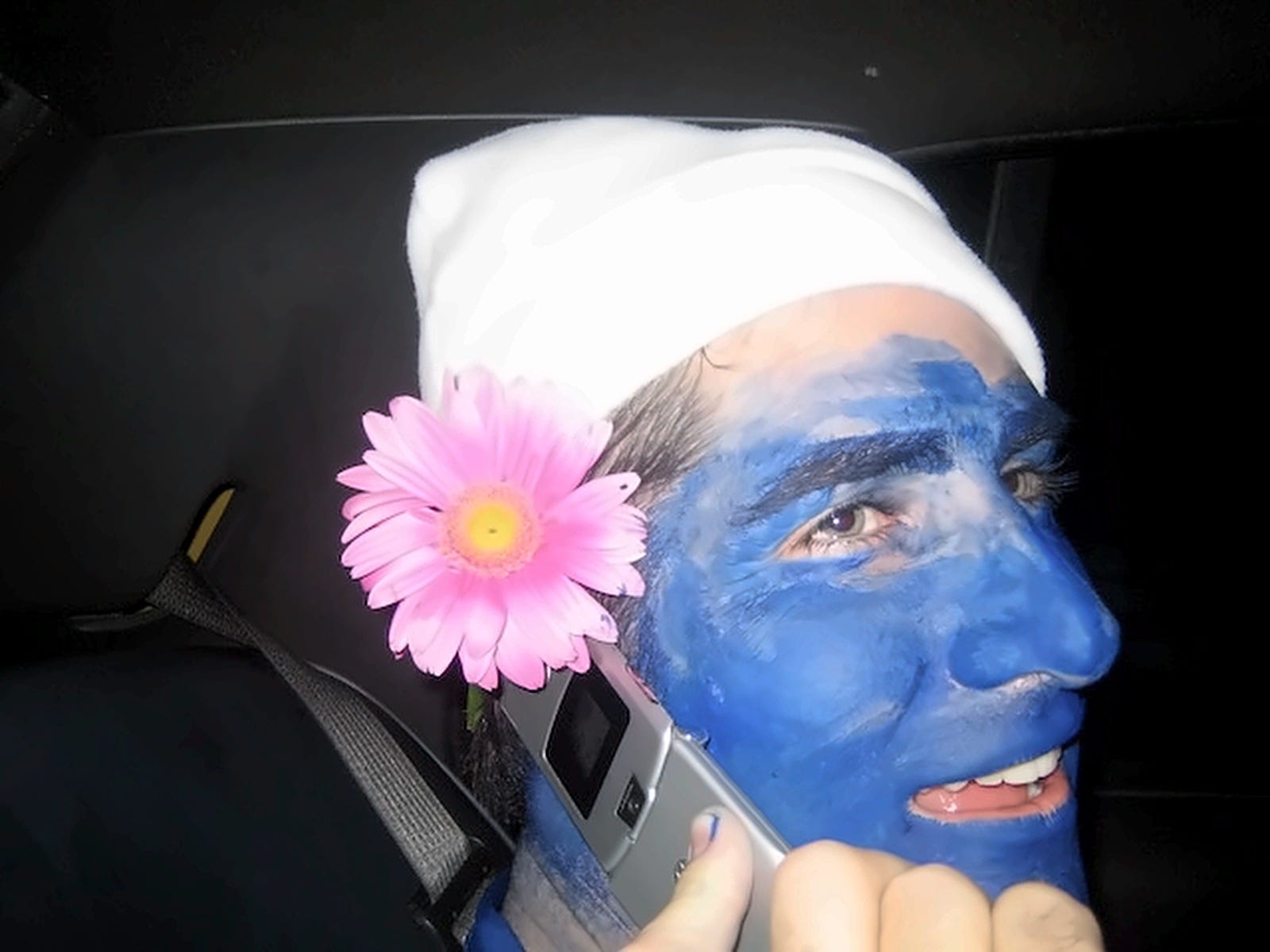
I lived in San Francisco, and David lived in New York. I visited him for Halloween. I suggested he come with me to a midtown party as a Smurf. Since I’d cobbled together that look a decade earlier, I had some expertise to share. This time, I knew how to keep the blue from smudging.
I have this photo of David, a vision of blue and white: white cap, white shorts, and big white shoes any clown would be proud to wear. He’s smiling ear to ear, showing off a little mirror like Vanity Smurf. I couldn’t tell yet whether this was his usual smile since it was only our second date.
When we stepped out of our cab on 42nd Street, everyone ran up to David. They all wanted a picture with a Smurf. He told me he’d never had so much attention on Halloween or any other day. What I remember most was his wonderment.
“Stick with me,” I said through a laugh. “We’re just getting started.”
Now, eleven years later, once-buttoned-up David is my fiancé.
Okay, here’s my confession. I don’t actually make anyone more gay.
Everyone does that for themselves. I try to give people space to feel more comfortable in their own skin. They don’t even have to be gay. Maybe someone will see me go crazy on the dance floor to a Wang Chung or Carly Rae Jepsen song and follow me.
For most of my childhood, I tried to edit out my effeminate side. Now I try to embrace all that flair, relaxing my wrists or crossing one knee over the other without judging or correcting myself. Still, censoring myself sometimes feels so natural, so protective, that I don’t even realize I’m doing it.
As a kid, I loved characters, performance, and wigs.
Costumes let me be different. Like too many kids, I also learned that some acting was off limits. In fifth grade, my older brother Bobby and I, along with our neighbor’s two kids, put on a show for our parents after a pasta dinner at their house.
“This will look great on you,” my brother goaded, holding up a loud tablecloth. “You’ll be the sailor’s wife.”
Long before that skit, he often encouraged me to try on our mom’s clothes. “Put on these high-heeled shoes. It’ll be fun,” he said before he pushed me out the front door into the February snow.
I love to dress up, but to this day I still despise any form of high heel.
In a dumpy, oversized tablecloth and a matted brunette wig, I looked horrible and far less feminine than I did in any of my perfectly coordinated Garanimals outfits. It may be the most heterosexual drag I’ve ever worn.
When I pranced through the makeshift proscenium arch in our neighbor’s living room, everyone laughed except my mom and dad. They stared motionless. Shortly after our performance, my parents said we had to go. The one-block walk home felt long. My mom walked ahead of everyone else, her shoulders up near her ears.
Bobby seemed oblivious to the tension and tried to crack a joke. Dad quickly shut him down. “Bobby, cut it out. Mommy has a migraine.”
That night, and many after, I hid under the covers in my pitch-black bedroom and began my evening prayers. “Now I lay me down to sleep.”
After the final line, “I pray the Lord my soul to take,” I went on to beg the Lord in a whisper, “What’s wrong with me? Please God, please make me normal.”
When morning returned, so did my optimism. Could I be special, but in a good way? Maybe I was a mutant whose powers hadn’t shown up yet, and someday I’d land at Xavier’s School for Gifted Youngsters.
In junior high and high school, I made myself deliberately small to hide.
I didn’t discover my power until my second year at Rutgers.
The parts of myself I was taught to hide gave me power, pleasure, and connection. People looked up to me and admired me.
Jim Anderson, a dean and my first gay role model, opened his home to me when I fought with my parents as they struggled to accept my sexuality. Being bold is easier when there’s somebody there to catch you.
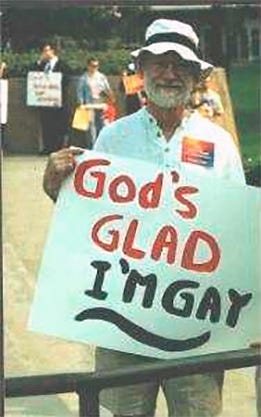
At Rutgers I stomped around in purple Doc Martens, silver hoop earrings, and my QUEER choker. Its pink-and-black beads were my exclamation point:
Don’t make me straight! Your comfort is not my problem.
I wanted to be so out I could never go back in, for fear I might. I took that choice away.
At a National Coming Out Day rally in 1990, I kissed my date, Patrick, on the steps of Brower Commons. It was about a year after I came out, and the kiss was far more than a peck on the cheek. A school photographer snapped our picture and asked whether he could publish it. “Yes,” I said, cutting him off.
My date hesitated.
I was the co-president of the Lesbian and Gay Alliance. How could he falter?
Patrick turned to me, not the photographer. I didn’t say a word. He wanted my approval before he said no. I couldn’t give him that. My look said it all: Do it.
Moments later, Patrick gave the photographer his permission and his name.
Four days later, a friend’s early morning call woke me up.
“Have you seen The Daily Targum, James? Your picture is on the front page.”
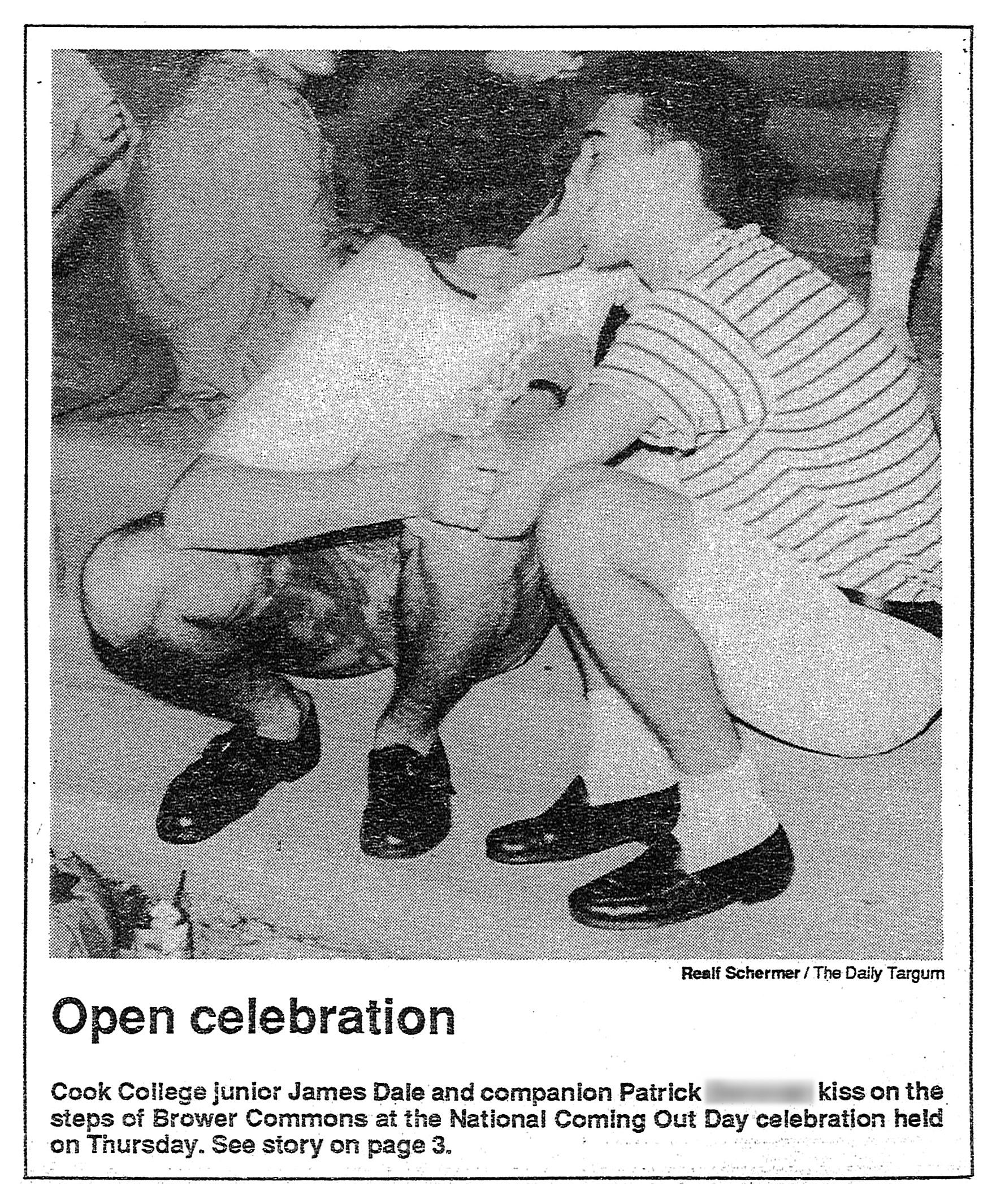
The campus response was immediate. Some students tore up the photograph. Others stapled it to their dorm doors in solidarity. For weeks, letters to the editor, residence hall debates, and rallies filled the campus. Professors even used the picture to spark discussions in lecture halls.
All this came two months after I’d been expelled from the Boy Scouts of America.
My offense: speaking to high school teachers as an openly gay teen at a Rutgers social workers’ conference. Scouting, the focus of my entire childhood, was suddenly ripped away because I said I was gay.
A few close friends knew Scouting had expelled me, but the media hadn’t run the story yet.
All the attention was an exhilarating distraction. Something I’d spent years hiding was front and center. No one could escape it. They could hate it, but they couldn’t ignore it, or me. Instantly, I was the gayest kid on campus.
Patrick and I each faced different kinds of fallout. He lived in my college town but wasn’t a student, and the photo was how his parents found out he was gay. While he dealt with their reaction, I was absorbed in the growing campus controversy and in explaining that kiss to my mom after her best friend Claudette used the photograph to get her worked up.
Patrick and I never talked about any of it. What could have brought us closer pushed us further apart.
Before the rally, we bonded over dancing. On our second date, Patrick took me to Sound Factory, an after-hours club in New York City. Madonna went there to watch people vogue. I had never danced in such a diverse space before, surrounded by hundreds upon hundreds of queer people.
That photo far outlasted our relationship.
Decades later, Patrick barreled toward me on another dance floor at six in the evening. “James!” he shouted, then picked me up and spun me around. It was meant to be fun and flirtatious, but at six foot one, I’m not used to being swept off my feet.
After some small talk, the infamous photo came up.
“Oh, you just liked all the attention,” he said as I cringed. He may have been right, but there was more to it. Patrick wasn’t political. He was just attracted to a guy who happened to be very, very out. I wasn’t about to relitigate the past few decades on a packed dance floor, so I laughed it off.
Then Patrick introduced me to his longtime partner.
Even knowing how difficult the photo had been for Patrick, I probably wouldn’t have done anything differently. That was who I was then. But it was a choice I’d wanted to make. I’m less sure it was his.
I knew what being that visible meant to me. I hadn’t considered what it meant to Patrick.
I love being the first person on the dance floor who gets others to join in.
Dancing always comes easily to me. Singing solo? Now that’s another matter.
I get stage fright. Show me injustice, and something instinctual takes over me. Put me at a piano, and I’m terrified I’ll forget the words.
Recently, on a trip to Atlanta, Julie, an ally turned friend, and I found Campagnolo, a restaurant that turned into a piano bar after dinner. I told her I wanted to sing. Then I kept putting it off.
“Come on, do it!” she urged.
When the pianist didn’t know my go-tos, I panicked. I was already standing in front of the room. But after some back-and-forth, we settled on “Dentist!” from Little Shop of Horrors. It was a stretch for him too, but I mistook his uncertainty for a lack of willingness to try harder.
The Southern crowd was far more subdued than at any New York City piano bar. I was being judgy.
Regulars sang. I overacted my way through, the only way I know how.
Julie sat at a table I couldn’t see. I felt like I was bombing as everyone went about their conversations. When I was done, I rushed to our seats and said, “Let’s get out of here.” Shortly thereafter, I realized I’d left my Visa card there.
The next day, we went back and stayed for a drink. I wasn’t looking for a second chance. After a few sips, I found my way back to the piano. Even though the pianist wasn’t that familiar with the ABBA song I’d practiced, he gave it a shot. Maybe he gets stage fright too.
Instead of shouting like Steve Martin’s sadistic dentist, I showed my softer side: Can you hear the drums, Fernando?
After I finished, the owner came up to the piano.
“I know who you are,” he said. “You’re the gay Boy Scout.”
He didn’t know my name. He knew my brand. It felt good and a bit vulnerable. I thought I was just an anonymous guy singing from another state.
“How did you know?”
He smiled. “You just look so familiar.”
Back at the table, Julie confessed that when the owner pressed her, she’d told him about my lawsuit against the Boy Scouts.
Before the night was over, I convinced Julie, a piano-bar virgin, to sing. “Hey, if I can do it, so can you,” I told her. She hedged at first, then asked for Leonard Cohen’s “Hallelujah.” It wouldn’t have been my choice. I’d never heard it at a piano bar before, but everyone joined in.
“You did great,” I told her.
“Well, it was more of a sing-along than a solo,” she corrected.
When the lights came on, we left on a high. I was totally wrong about that Atlanta restaurant-turned-piano bar.
A lifetime of being visibly gay hasn’t made me immune to stage fright. Sometimes I worry how people will react. Sometimes it takes a friend. Sometimes I need to stay for a drink.
In the ’90s I was the gay Boy Scout, the perfect plaintiff.
I gave them the straight version of myself to negotiate acceptance. If they stopped listening because I was “queer” instead of “gay,” or because my motorcycle jacket and hoop earrings didn’t seem approachable, they would have never heard my argument for fairness and equality.
The censoring happened gradually, bit by bit. With every little edit, I watched their reactions improve. Sometimes I’m lucky because I can present a “passable” version of myself. Other times I fear I’m playing gay on someone else’s terms.
When I hear, “You’re the gay Boy Scout,” it’s as if I’m being forced into a costume I’ve long since outgrown. It’s a sobering spotlight that commands my attention and, without my realizing it, straightens me up.
When I first came out, I forced my flamboyance. I needed to find the boundaries of my femininity, of how comfortable I could be being gay. Some would ask, “Why do you have to act so gay?” Today I’m not forcing it. I’m just trying to accept it, and I love to bring people along.
I don’t always acknowledge that I’m gay. Sometimes it’s easier to let them assume whatever they want. Correcting them and saying “hey, I’m gay” can bring a moment of vulnerability; other times the fear lasts a bit longer. But life has taught me I can always take more chances than I think. At 56, there’s so much more fun in me that I can’t wait to let out.
When I look back at that Halloween photograph of David, I remember the pleasure of sharing something I already loved and watching the person I fell in love with discover it too. I knew how to do the blue. David supplied the wonderment.
People like Julie have given me that feeling, too. They still do.
Okay, I make people more gay. Luckily, people do the same for me.
"Censoring myself sometimes feels so natural, so protective, that I don't even realize I'm doing it." So true for so many gay men. And David as a Smurf on your second date 😂 Congrats on the engagement, James!
Even just reading this made me more gay.
I think I'll put on my Chicago Pride 2018 t-shirt.